
Your dog isn’t misbehaving when you leave. They’re panicking.
A 28-day starter plan that helps you work toward calmer alone time, one small, scored step at a time. No punishment, no flooding, no guesswork.
- ✓A 0 to 5 Panic Scale and clear rules for what to do after every session.
- ✓A Coverage Plan for the hours you can’t train, built for people who work.
- ✓A safe-space setup designed to help alone time feel less overwhelming.
Instant PDF · Reward-based approach · Vet-first guidance
You’ve come home to a chewed door frame. Again.
Maybe a neighbour mentioned the barking. Maybe you’ve sat in the car, dreading the walk to your own front door. Maybe you’ve searched for answers late at night and felt awful for even having the thought.
You’re not a bad owner. You’re an exhausted one. You’ve been told to “just ignore it” or that your dog will get used to it. You’ve tried a new toy, a longer walk or a crate. The panic may still be there when you reach for your keys.
Your dog isn’t punishing you. They’re having a hard time, and scolding can add more fear to an already difficult situation.
Why random tips can leave you stuck
Too many disconnected ideas. A new toy one day, ignoring them the next, music after that. It’s hard to understand what is helping.
Too much, too soon. Long absences before your dog is ready can push practice beyond their comfort level.
No plan for difficult days. Without clear checkpoints, it’s hard to know whether to repeat a step, slow down or seek support.
The goal isn’t to push through panic.
It’s to follow a consistent plan, observe your dog’s response and adjust the next step accordingly.
Score it. Stay below it. Step up.
Instead of guessing how your dog is doing, use a repeatable process to observe, record and decide what comes next.
Look
Use the 12-question Anxiety Audit and record your dog’s starting point honestly.
Prepare
Set up a safe space, plan cover for unavoidable absences and make departure cues less dramatic.
Practise
Use short sessions within your dog’s comfort level and score observations from 0 (calm) to 5 (panic).
Adjust
Review three calm sessions before progressing. After a hard day, step back without guilt.
Everything in the guide, organised into one plan.
Practical guidance, step-by-step practice and printables to help you understand your dog’s responses and make informed adjustments.
The Anxiety Audit
A quiz, trigger checklist and a structured way to record your dog’s starting point.
Vet-first guidance
Learn which medical issues can resemble separation-related distress, how to prepare for a vet conversation and when to seek specialist support.
A practical Coverage Plan
Think through daycare, sitters, family help and staggered schedules for the hours you cannot train.
The Safe Space Setup
Consider a crate, pen or room, with a gradual five-day setup plan focused on comfort.
Week 1 to Week 4
A day-by-day starter structure covering foundations, duration building and real-life practice.
Tools and enrichment
Explore helpful equipment, enrichment ideas, Kong and lick-mat recipes, and exercise basics.
Hard-day troubleshooting
Guidance for setbacks, weekends, apartments, full-time work, neighbours and households with two dogs.
Printables for everyday use
Daily logs, Panic Scale card, trigger checklist, departure cue cards, weekly tracker, coverage planner, house rules and vet visit sheet.
See the kind of structure you’ll be working with.
Use the guide’s worksheets and planning pages to make observations easier to record and review.
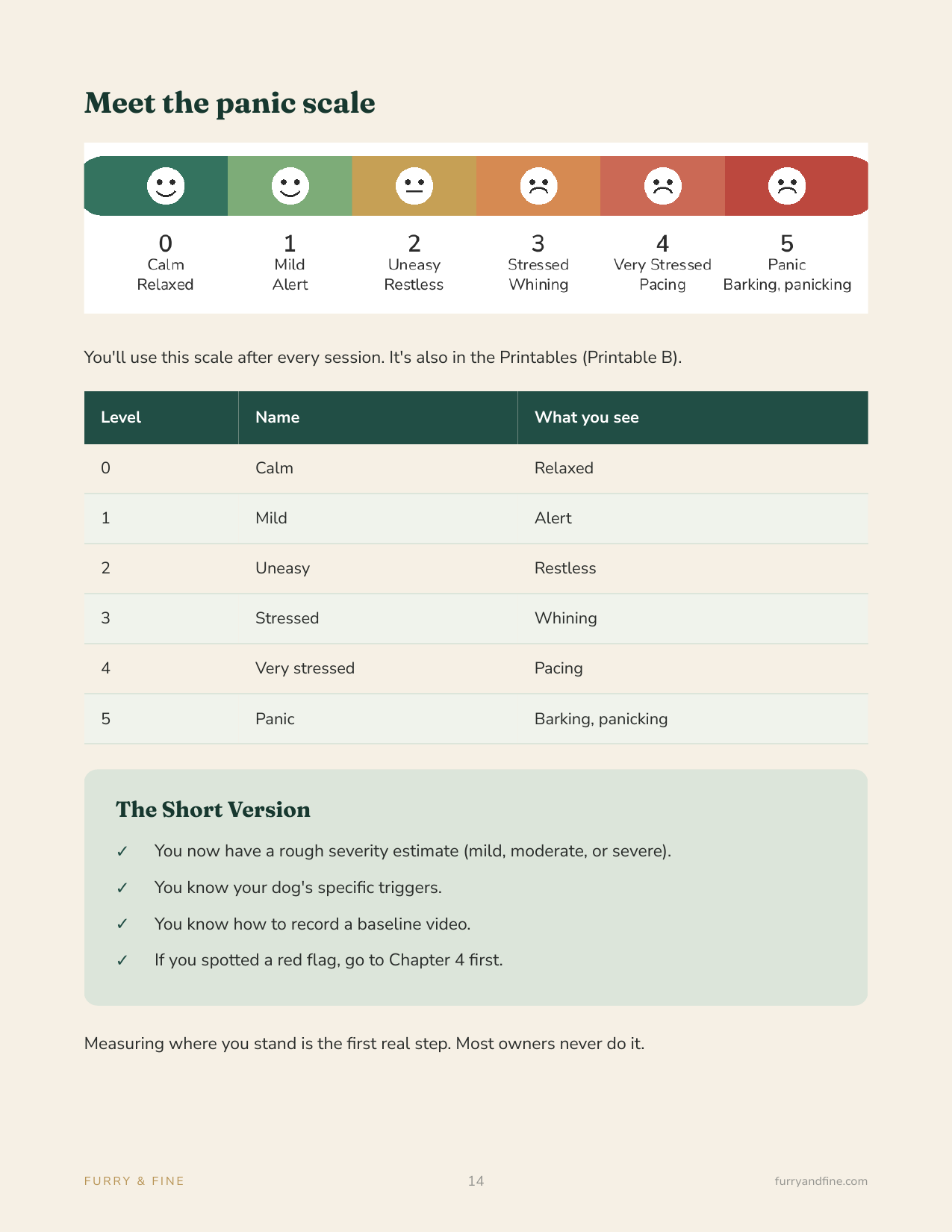
Understand your dog’s starting point
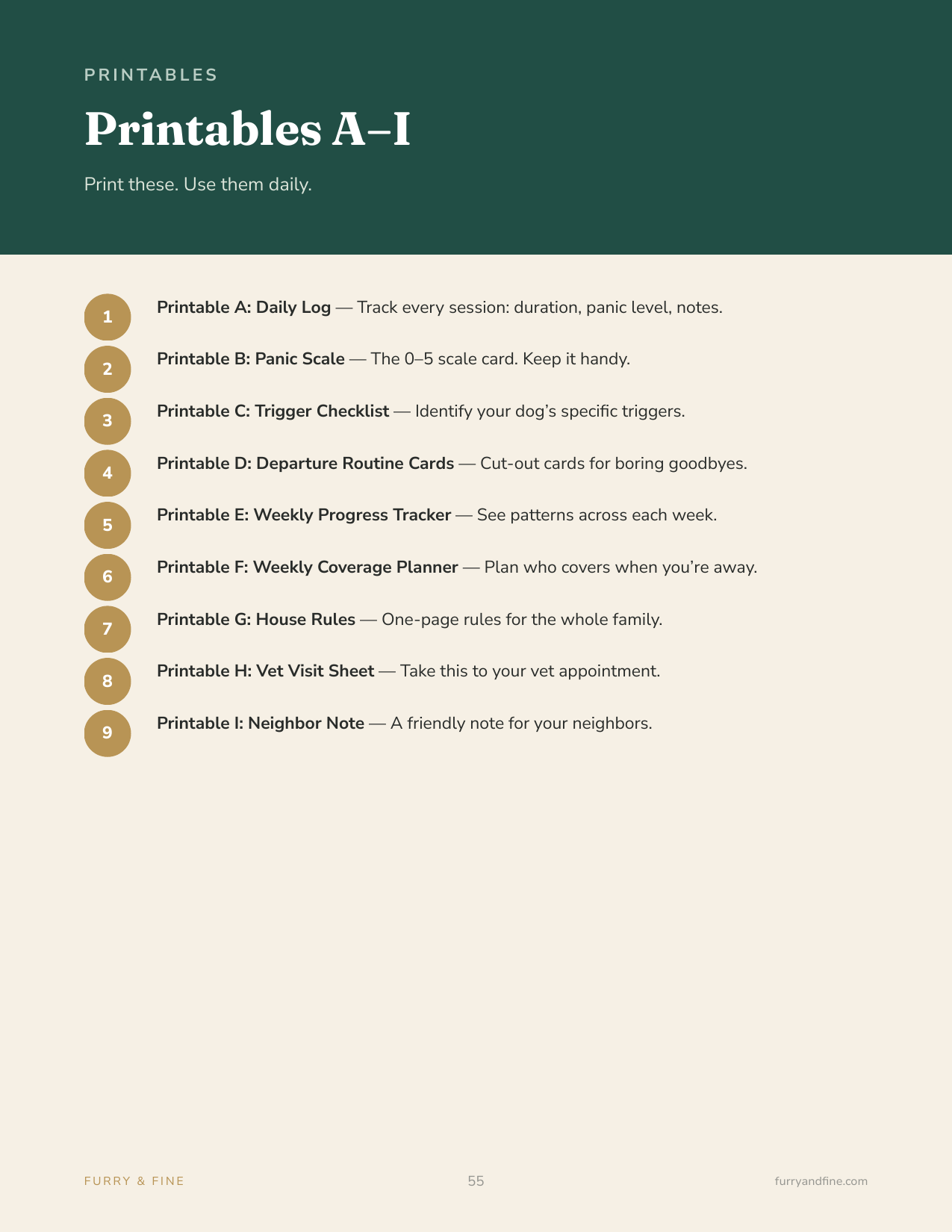
Follow a structured practice plan
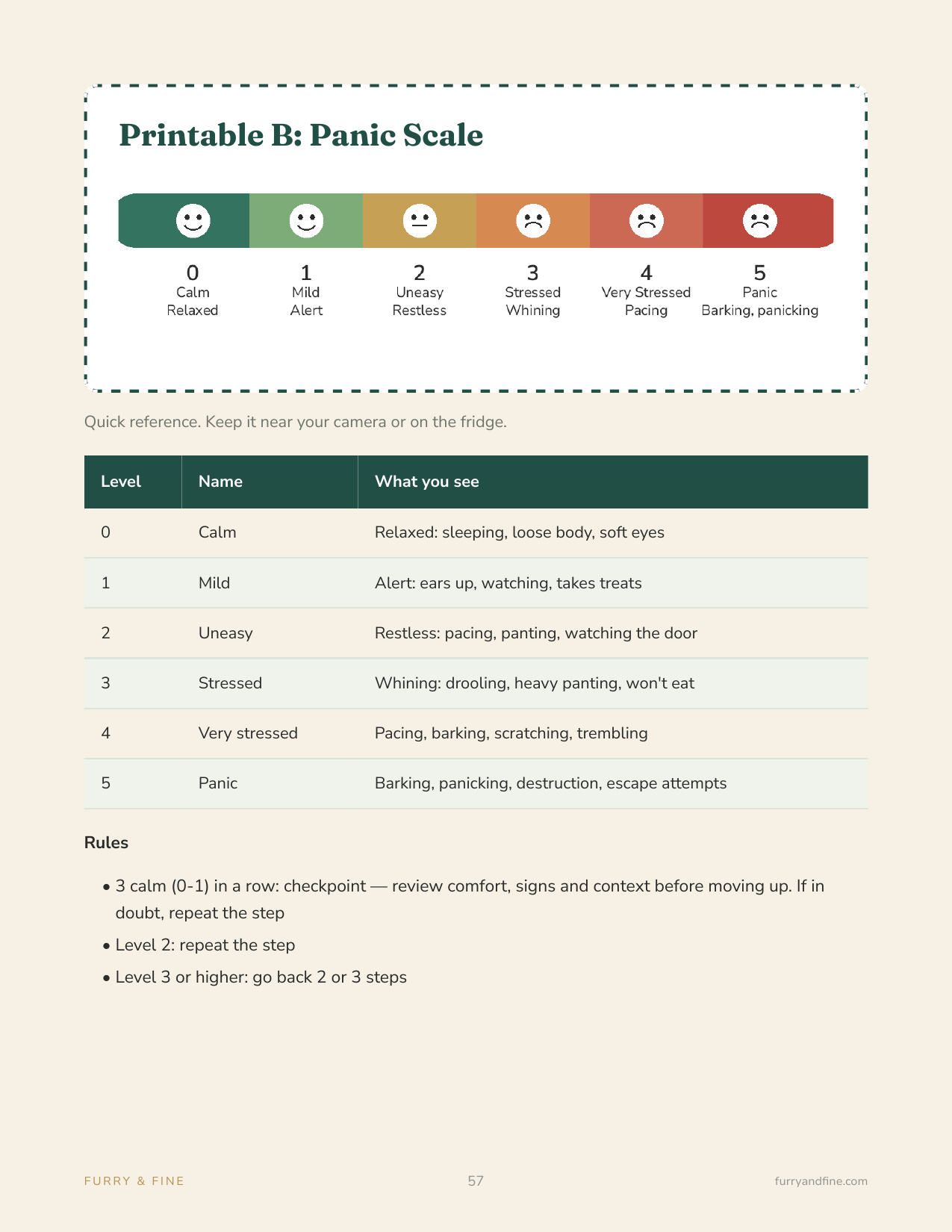
Record sessions and review progress
Preview images are illustrative samples of the digital guide. The product is delivered as a PDF.
Less guessing. A clearer next step.
Progress may look small at first. A quicker settle, a relaxed body, or one calm minute worth recording can give you useful information about what your dog is ready for.
The guide is designed to help you observe those moments, respond thoughtfully and recognise when professional help is needed.
- Read the signals: distinguish calmer, uneasy and stressed behaviour more systematically.
- Choose the next step: use clear checkpoints instead of improvising after every session.
- Notice small wins: record changes that may be easy to overlook from memory alone.
- Plan around work: think ahead about absences your dog may not yet be able to manage.
- Know when to ask for help: identify situations that call for veterinary or specialist support.
What we won’t promise.
We can’t promise your dog’s anxiety will be resolved in 28 days. No honest plan can guarantee that. The 28 days provide a starting structure, while your dog sets the pace.
These are general patterns, not predictions or guarantees. Individual dogs vary, and some need a slower plan and professional support.
A useful starting point for the right situation.
This guide may suit you if:
- Your dog whines, paces, drools or barks when you leave.
- You want a gentle, step-by-step plan to follow at home.
- You prefer one consistent approach over a collection of random tips.
- You need to plan around a job or unavoidable daily commitments.
Start with your vet if:
- Your dog has injured themselves while trying to escape.
- The behaviour started suddenly or is getting worse.
- Your dog is showing severe distress.
- You suspect pain, illness or another medical issue may be involved.
Getting professional help early is part of the plan, not a detour.
Start with what you need. Add equipment thoughtfully.
The guide discusses practical setup choices, including safe spaces, enrichment and ways to observe your dog during alone time.
Equipment costs can vary. The guide gives a rough gear estimate of $100–$250 and recommends prioritising a camera before adding other items as needed.
You don’t have to buy everything at once.
A camera can make it easier to score sessions and observe behaviour, but the guide also includes a no-camera method.
Choose equipment around your dog’s needs, safety and comfort rather than assuming that more gear automatically means more progress.
Alone But Okay: A 28-Day Starter Plan
A practical guide to help you observe, plan and practise at your dog’s pace.
Bring a little more structure to alone-time training.
- The complete 28-day starter guide
- Printables A to I for your own household
- An Anxiety Audit and 0 to 5 Panic Scale
- A practical Coverage Plan for work days
- Safe-space setup and step-by-step practice guidance
- Troubleshooting, maintenance and vet-first guidance
- Instant digital download
Personal-use licence. Print the worksheets for your own household; please don’t share, resell or redistribute the file.
The Calm Alone-Time Toolkit contains 24 printable worksheets and planners for tracking sessions, setbacks and weekly decisions.
The supplied sales copy lists the two-product bundle at $22.99, compared with a combined standalone value of $25.98.
Visit Furry & Fine to explore the brand’s resources.
Thoughtful guides for happier pets.
Furry & Fine creates practical educational resources for pet owners who want a clearer way to care for their animals.
Alone But Okay is built around widely used, reward-based training principles. It puts your dog’s comfort ahead of the calendar and explains when a veterinarian or a certified separation anxiety trainer may be needed.
This guide does not claim veterinary or professional trainer credentials. Its purpose is to offer clear structure, honest limitations and safer starting points for everyday learning.
More about Furry & FineA few things you may want to know.
Will this fix my dog’s anxiety in 28 days?
No result or timeline can be guaranteed. Mild cases may take around four weeks, moderate cases may take six to twelve weeks, and severe cases may take several months, often with professional support. These are rough patterns, not predictions. Your dog sets the pace.
I work full-time. Can I still use the plan?
The guide includes a Coverage Plan for hours you cannot train and discusses a slower approach that can work around a busy schedule, including a version built around one 10–15 minute session a day. Your dog’s needs and comfort still determine the pace.
I’ve tried things before and nothing worked. What’s different?
The guide brings the process into one consistent structure: observe, score, review and adjust. It emphasises staying within your dog’s comfort level and gives you a way to respond to difficult days rather than pushing through them.
Will it work for a rescue or senior dog?
The gentle approach may be useful for many dogs. For senior dogs, sudden behaviour changes or possible medical issues, consult your veterinarian first to rule out pain, illness or cognitive changes.
Do I need a pet camera?
A camera can make scoring and observing sessions easier, but the guide also includes a no-camera method. Choose a method that lets you observe safely without adding to your dog’s distress.
I have two dogs. Does the guide cover that?
Yes. The guide discusses starting with separate training before working with both dogs together.
What if my dog’s score is very high?
A high score is a reason to prioritise safety and seek help. The guide discusses a holding plan while you contact your vet and arrange appropriate professional support. If your dog is at risk of injury, don’t rely on a PDF alone.
Can I print the guide’s worksheets?
Yes. You can print the worksheets for your own dog and household as often as needed. Please don’t share, resell or redistribute the digital file.
How much equipment will I need?
The guide gives a rough gear estimate of $100–$250, though your actual costs may vary. It recommends prioritising a camera and adding other items as needed. It also includes a no-camera method.
Where can I ask a question?
Email support@furryandfine.com for questions about Furry & Fine resources.
You don’t have to fix everything this week.
You need a plan and the patience to go at your dog’s pace. The structure is here. You bring the patience.
If your dog has injured themselves trying to escape, or their behaviour changed suddenly, please start with your veterinarian.
Educational disclaimer: Alone But Okay is an educational resource based on widely used, reward-based training principles. It is not veterinary, medical or professional behaviour advice and does not diagnose or treat any condition. Every dog is an individual, and results and timelines vary. If your dog’s distress is severe, sudden, worsening or poses a risk of injury, work with your veterinarian or a certified separation anxiety trainer. Personal-use licence: please don’t share, resell or redistribute the file.