
Training only works if you can see what’s working.
24 printable worksheets and planners that turn “I think he’s better?” into a clearer record, a clearer review and a clearer next step.
- ✓Score each session and spot the trend, not just the bad days.
- ✓Use a Setback Planner to turn a hard day into a practical decision.
- ✓Review the week to decide whether to repeat, step up or step back.
Printable PDF · Personal household use · Instant digital download
Some days feel like progress. Some days feel like starting over.
You’re doing the work: short sessions, predictable goodbyes and enrichment in your dog’s safe space. But by Thursday, can you remember whether Tuesday was a 1 or a 3?
One difficult day can make you wonder whether all the effort has been undone. When you’re tired and worried, memory isn’t always a reliable guide.
A written record gives you something more useful to review: what happened, what you noticed and what you may want to change next.
When everything stays in your head
Sessions blur together. It’s difficult to compare today’s observations with the details of a few days ago.
A hard day feels bigger. Without a record, one setback can overshadow quieter signs of progress.
The next step feels unclear. You may not know whether to repeat a session, adjust the setup or seek advice.
Records don’t replace good training.
They support observation and planning, helping you make decisions with more context rather than relying on memory alone.
A practice companion, not a training plan.
The Toolkit helps you record observations, review patterns and organise next steps. It does not replace the step-by-step training instructions in Alone But Okay or guidance from your veterinary and training team.
Observe
Record your dog’s baseline, session details and the behaviour you notice.
Review
Use weekly reviews and progress tools to look for patterns across sessions.
Adjust
Use the information to consider whether to repeat, step back or seek support.
24 pages that help you keep track.
A printable set of worksheets, logs and planning pages to help you document your dog’s alone-time practice and organise what you learn.
Get started
How to Use Your Toolkit, plus a one-page Quick Reference with the Departure Cue Ladder.
Record your baseline
My Dog’s Starting Point and a three-day Alone-Time Baseline Tracker.
Log daily sessions
Daily Training Log, Before You Leave Checklist, observation sheet and after-practice reflection.
Review and adjust
Progress Tracker, Weekly Review, Comfort Signals Reference and Setback and Adjustment Planner.
See the bigger picture
Progress Dashboard and Monthly Baseline Comparison for reviewing changes over time.
Plan routines and support
Routine Planner, Trigger and Pattern Journal, Enrichment Ideas and a Support Plan for your vet, carers and trainer contacts.
Reflect on what you’ve learned
My Biggest Learnings, My Next-Step Plan and a Progress Reflection page.
Print and write
Use the worksheets to keep your household’s observations and planning together in one place.
Give your observations a place to live.
Use printable pages to record what happened during practice and make your weekly review more useful.
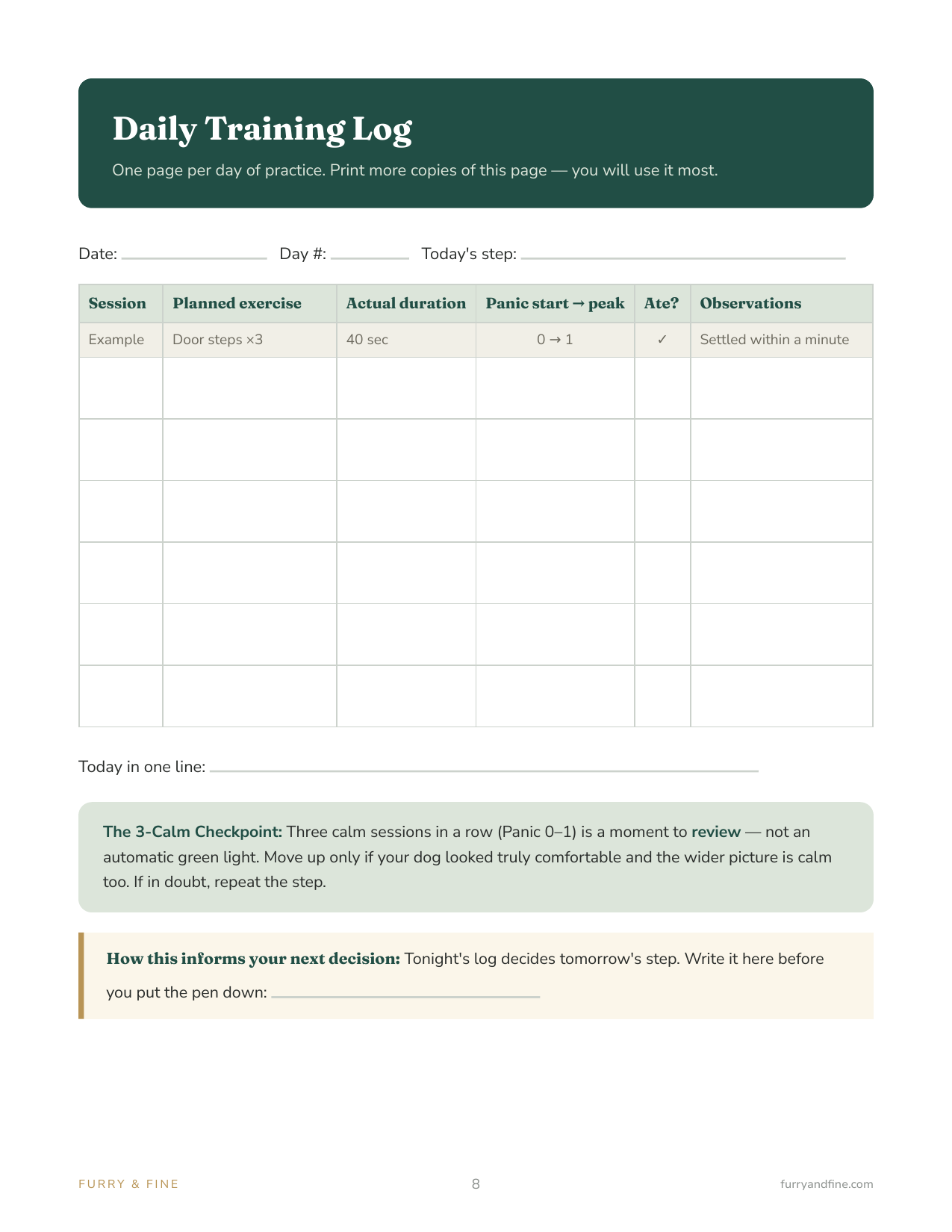
Observe and record
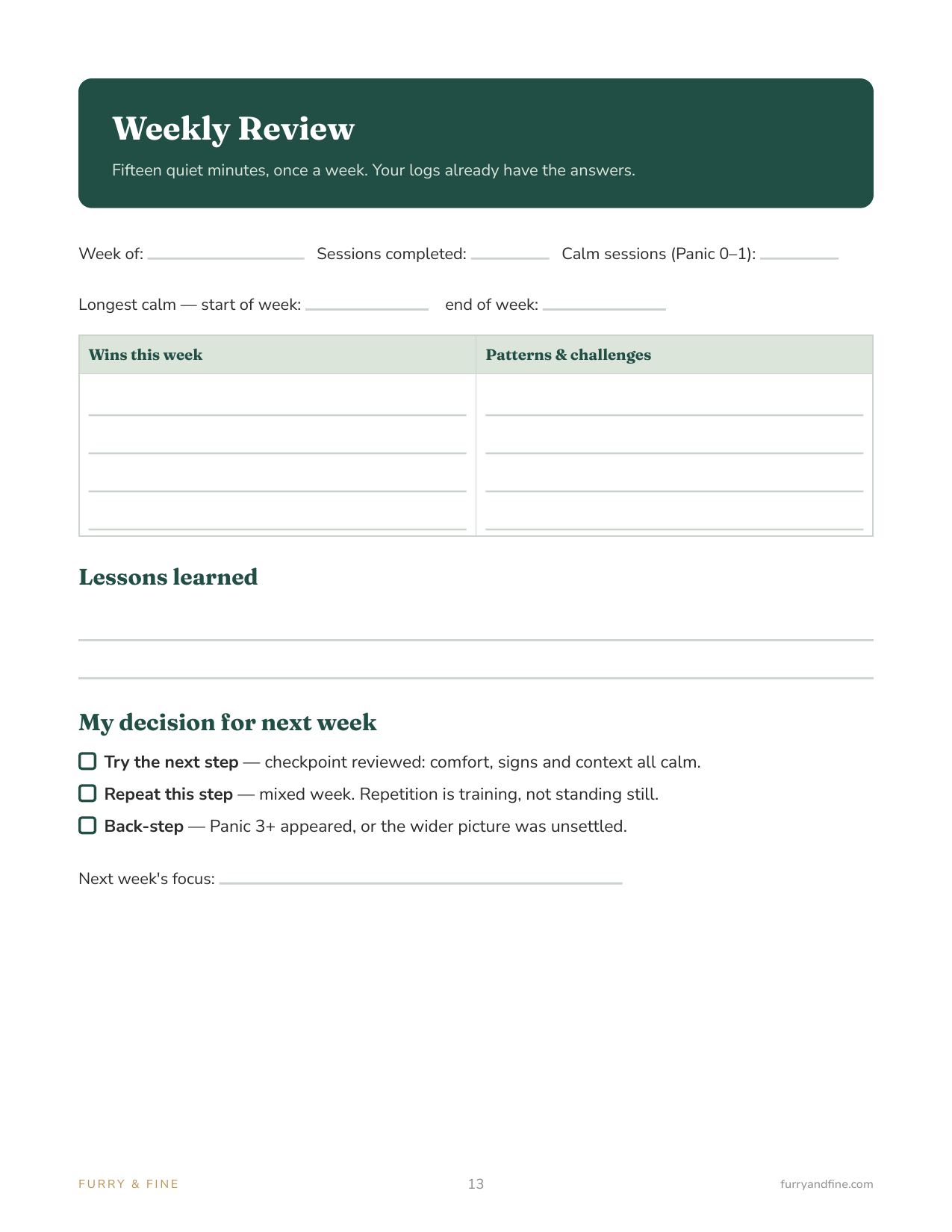
Review patterns over time
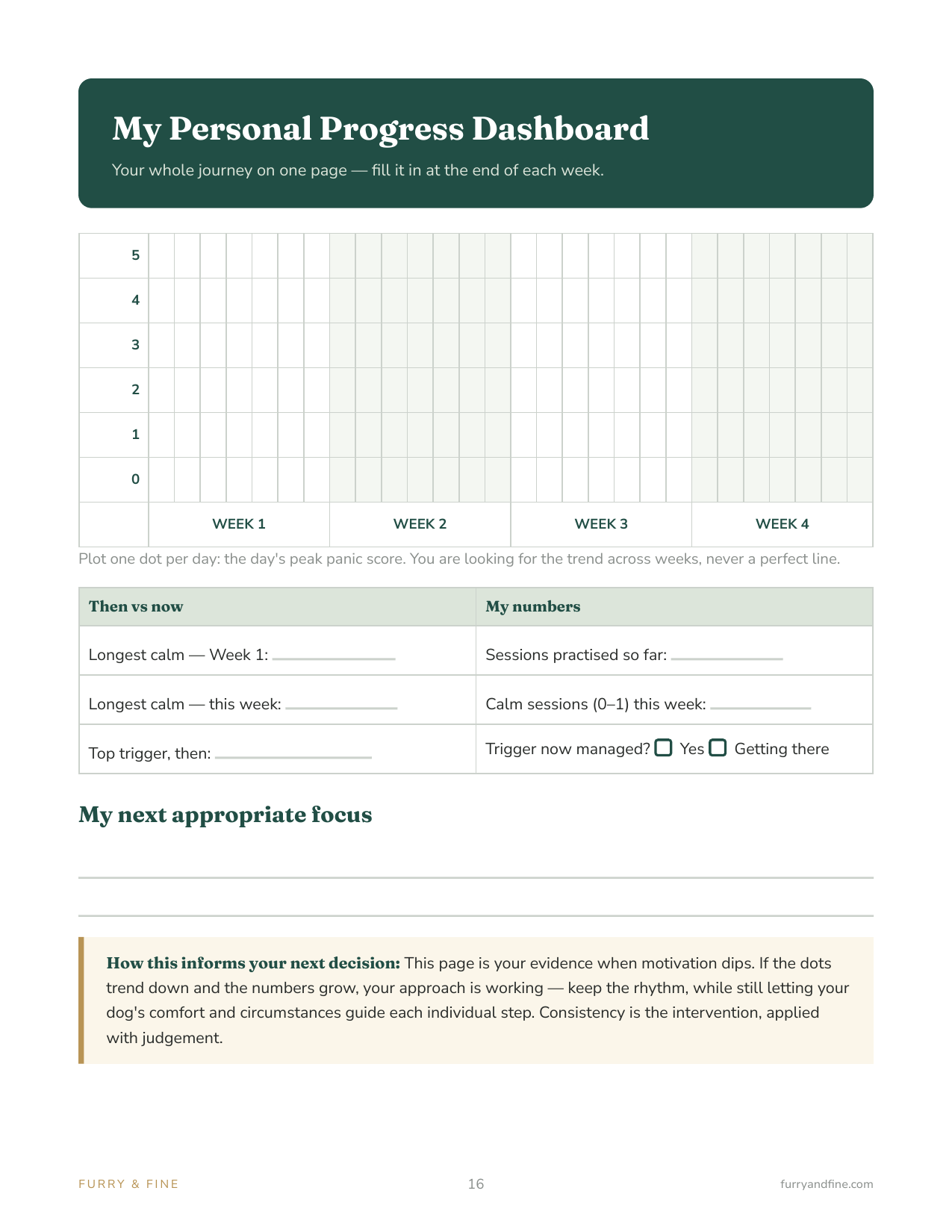
Plan your next decision
These are sample previews of the printable digital product.
Make the small progress visible.
Progress isn’t always dramatic. It may appear in a series of small observations that are difficult to remember accurately from one week to the next.
The Toolkit gives you a consistent place to record those details, review them and prepare for the next practice session or professional conversation.
- Stop guessing. Give each session a score and a note.
- Learn from hard days. Record setbacks and consider a measured adjustment.
- See patterns. Review observations across multiple days.
- Make informed decisions. Use records to help decide what to repeat or discuss with a professional.
- Prepare for appointments. Bring organised observations to your veterinarian or trainer.
- Keep everything together. Use a dedicated collection of worksheets rather than scattered notes.
Know what you’re getting before you buy.
The Toolkit may suit you if:
- You’re already following an alone-time training approach.
- You want records to support your decisions, not just how the day felt.
- You like printing, writing and keeping a visible progress record.
- You want to organise observations for your vet or trainer.
You may need a different starting point if:
- You need a complete step-by-step training plan. Consider Alone But Okay or the bundle.
- Your dog is severely distressed or injuring themselves. Contact your vet or a certified separation anxiety trainer.
- You expect a workbook alone to resolve anxiety. The Toolkit supports observation and planning; it cannot promise that outcome.
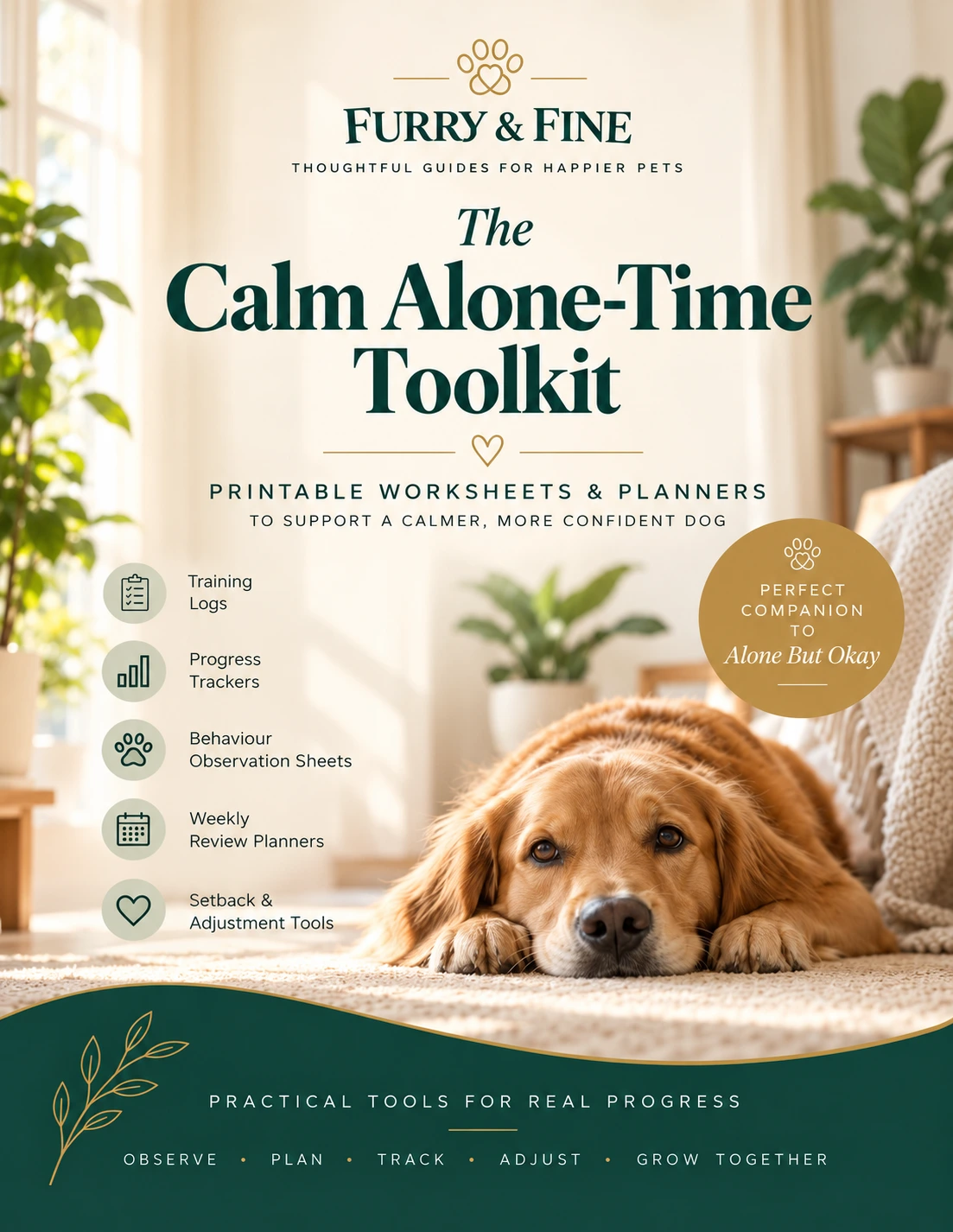
The Calm Alone-Time Toolkit
Keep session records, review patterns and organise your next steps with 24 printable worksheets and planners.
A clearer record of your dog’s alone-time practice.
- 24 printable worksheets and planners
- Baseline and daily session tracking
- Weekly reviews and progress dashboard
- Setback and adjustment planning
- Comfort Signals Reference
- Routine, trigger and support planning pages
- US Letter format for printing
- Instant digital download
Personal-use licence. Print for your own dog and household. Please don’t share, resell or redistribute the file.
Alone But Okay provides the 28-day starter plan, while the Toolkit helps you track sessions, setbacks and progress.
Get both together in the Calm Alone-Time Starter Bundle for $19.99 instead of $25.98 — save $5.99.
View the Alone But Okay guide →Thoughtful tools for happier pets.
Furry & Fine creates practical educational resources for pet owners who want a clearer, more thoughtful way to care for their animals.
The Calm Alone-Time Toolkit is designed as a practice companion to Alone But Okay. It supports observation and planning while keeping the dog’s comfort at the centre of the process.
The Toolkit is not veterinary advice, a diagnostic tool or a substitute for professional training support.
More about Furry & FineBefore you choose the Toolkit.
Can I use the Toolkit without Alone But Okay?
Yes. It can be used on its own for observation and planning. Its opening pages introduce the Panic Scale and checkpoint rule. The full step-by-step training process is explained in the Alone But Okay guide.
How is it different from the printables in the guide?
The guide includes simpler printables. The Toolkit is the fuller collection, with per-session logs, setback and weekly decision pages, a body-language reference, a dashboard and a monthly baseline comparison.
Do I need a camera?
No. The Toolkit itself does not require a camera. You can record observations using a suitable method that allows you to observe safely without increasing your dog’s distress.
Can I fill it in on screen?
The Toolkit is designed to be printed and completed by hand. Interactive or fillable PDF fields are not promised.
How many times can I print it?
You can print the worksheets as often as you need for your own dog and household. Please don’t share, resell or redistribute the digital file.
Will this workbook fix my dog’s anxiety?
No workbook can promise that. The Toolkit helps you record observations and organise decisions. Every dog is different, and severe distress may require veterinary and professional separation anxiety support.
What if my dog is injuring themselves or is severely distressed?
Contact your veterinarian or a certified separation anxiety trainer. The Toolkit is an educational aid, not a substitute for professional assessment or support.
Where can I ask a question?
Email support@furryandfine.com for questions about Furry & Fine resources.
Let your notes help guide tomorrow’s decision.
Print a few pages, record a session and give your observations a consistent place. Small details can be easier to review when you don’t have to rely on memory alone.
Educational disclaimer: The Calm Alone-Time Toolkit is an educational training aid based on widely used, reward-based principles. It is not veterinary or medical advice and does not diagnose or treat any condition. The Panic Scale is a personal observation aid, not a validated diagnostic tool. Every dog is an individual, and progress and timelines vary. If your dog’s distress is severe, sudden or getting worse, work with your veterinarian or a certified separation anxiety trainer. Personal-use licence: please don’t share, resell or redistribute the file.